New West KnifeWorks Review: The Last Knife You'll Ever Have to Buy
A chef's honest review of New West KnifeWorks -- American-made, hand-finished in Idaho, and sharper than anything I've cooked with. With video.
The vines blur past on Highway 29, that deep Napa green that tells you excellent food and hospitality are everywhere around you. I'm driving to St. Helena for a knife. Two hours from the Bay. And I'm not second-guessing it for a second.
There's a version of this story where I walk into a beautiful store, get sold something beautiful, and write a beautiful review. That's not this story. This is the story of a knife that made me rethink every tool in my kitchen – and the people behind it who earned that reaction.
Born in Wyoming. Made in Idaho.
New West KnifeWorks started as a line cook's side project in Jackson Hole, Wyoming. That detail matters more than any spec on the blade.
Marco Pierre White once said that a cook becomes a chef when labor transforms into art – when the person behind the food has ground their teeth through enough repetition, enough failure, enough reflection, that what comes out the other side is no longer just technique. It's perspective.
Corey Milligan, the founder, was that person. Not someone with opinions about knives. Someone who had been in the trenches, felt the drag of a bad blade on a long service, and decided to build something better. The result is a knife made with equal parts brain, labor, and heart.
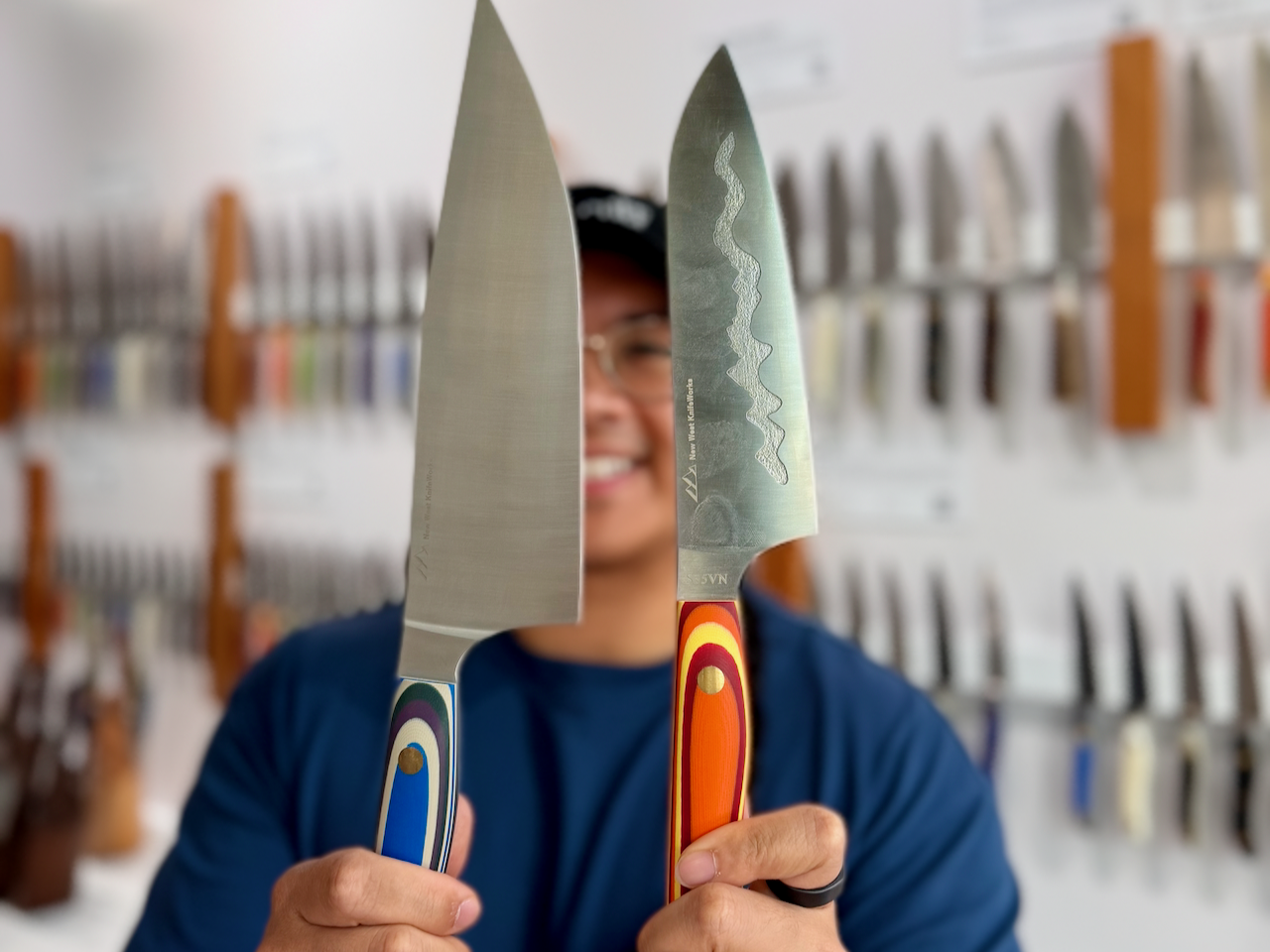
Every blade is still made by hand in Victor, Idaho -- a small town at the base of the Teton mountain range. The steel is S35VN, American powder steel, laser engraved right on the blade. The handle material is the same G10 composite used by U.S. Special Forces. Lifetime free sharpening, guaranteed.
This is not a knife built for the shelf.
What It Actually Feels Like
I picked up the 8-inch Cadet and my first thought was: this is a Japanese knife. Light. Agile. Fast in the hand. The kind of blade that disappears when you're working and just lets you cook.
My second thought was: no, it's something else entirely.
It has the agility of a Japanese knife with none of the fragility. You can feel the durability in it -- the confidence of a blade that isn't going to chip on your first prime rib, your first barbecue, your first hard ingredient that a delicate Japanese knife would flinch at. The balance point sits exactly at the pinch grip, so a knife that should feel substantial feels like nothing.
I've held a lot of knives. I've never held anything quite like this.
What the Store Manager Told Me
Pearce runs the St. Helena store – quiet, genuine, the kind of person who isn't selling you anything because he doesn't need to. He believes in what he's talking about.
I asked him what most people don't notice until they've used one for a year.
"You're supporting people at home, you're supporting local artists," he said. "We make it in Victor, Idaho. People who gravitate towards us connect with that."
Then I asked him about Japanese knives, because that's what most serious home cooks are reaching for.
"Japanese knives will literally chip on the first barbecue you do. The first prime rib. And those chips -- they ruin it."
He's not wrong. If you've owned a Shun or a Global and put it through serious work, you know exactly what he means.
The 8-Inch Cadet and the Sunburst Fillet Knife
The Cadet is the everyday knife. On the cutting board it is one of the sharpest blades I've used, full stop. Slicing through food feels effortless in the way that good tools always feel effortless – you stop thinking about the knife and you just cook. Flow state. No wrestling the ingredient, no drag, no resistance. Just the food.
The 7-inch Sunburst fillet knife I took to a whole branzino. It made me feel like a better fish butcher than I am. That's the highest compliment I can give a blade – it closed the gap between my skill and the result I was after.
Both knives have the same signature: they feel like Japanese knives until you use them hard, and then they feel like something tougher and more permanent.
Is It Worth It?
Yes. A hundred thousand times yes.
The feel is there. The craft is there. The looks are there. And the cost per use, across a lifetime of cooking, makes this one of the smartest purchases you can make in your kitchen.
I've spent years obsessing over where my food comes from. The quality of an experience flows from the quality of what goes into it -- top down, every step of the chain. The best ingredients deserve the best preparation, and preparation starts with the tool in your hand.
This is that tool.
Shop New West KnifeWorks and use code GERONIMO10 for 10% off: newwestknifeworks.com/GERONIMO10
Affiliate link. I earn a small commission if you purchase at no extra cost to you. New West KnifeWorks sent me the knives as part of a paid partnership.
Kain na! 🔪